1. Introduction
For many investors asking, “How can I get high growth from an electric-vehicle and technology leader while navigating increasing competition and macro uncertainty?” — the name that repeatedly comes up is Tesla, Inc. (TSLA).
With its combination of EV manufacturing, energy-storage business, Autopilot/Full Self-Driving ambitions, and a market-cap in the trillion-dollar neighborhood, Tesla is a company with huge upside and equally meaningful risks. In this article, we’ll dive into Tesla’s overview, recent performance, stock outlook, key growth drivers, and how investors might incorporate it into a portfolio.

2. Company Overview
Tesla, Inc. is a U.S.-based technology and automotive company led by Elon Musk. It designs, manufactures and sells electric vehicles (EVs), solar energy generation systems, energy storage products (such as Powerwall, Megapack), and related services. Tesla’s goal transcends cars: it aims to accelerate the world’s transition to sustainable energy.
In 2025 Tesla is navigating through a challenging growth chapter:
- Q2 2025 revenue dropped to approx. US$22.5 billion, down about 12% year-over-year.
- Q2 vehicle deliveries were ≈384,000 units, down about 13% from a year earlier.
- On the other hand, Tesla’s energy-storage business is gaining traction: Q3 2025 deployment of 12.5 GWh, up ~81% y/y.
- Despite the headwinds, Tesla remains widely watched for its innovation potential and disruption scope across multiple industries.
3. Stock Outlook & Key Drivers
Recent Stock Performance
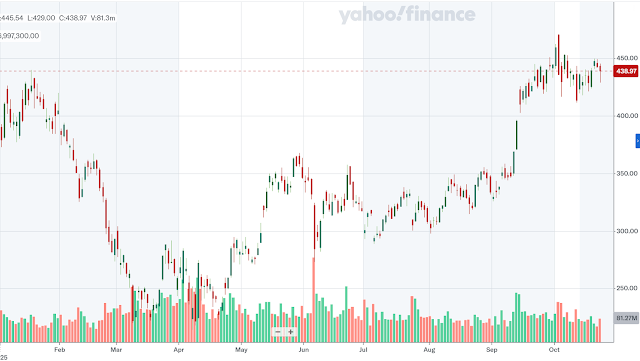
As of late 2025, Tesla’s stock (TSLA) has rebounded above the US $400 level, marking a strong recovery from its mid-year range of around US $320–350 and well off the April lows near US $214. Earlier in 2024, the stock reached as high as US $480 before undergoing a sharp correction driven by weaker vehicle deliveries, rising competition from Chinese and European EV makers, and margin pressure amid broad-based price cuts.
Investor sentiment had also been dented by concerns over Elon Musk’s political activity and its potential effect on Tesla’s brand image.
Now, with improving delivery momentum, renewed optimism around next-generation models, and growing investor interest in Tesla’s AI and energy-storage ambitions, the market has reassessed its outlook. While the stock still trades at a premium valuation thanks to its long-term innovation narrative, investors are increasingly demanding consistent execution and profitability visibility before assigning higher multiples again.
Valuation & Sentiment
Tesla’s valuation remains elevated: as per recent commentary, its price-to-earnings ratio crossed 250+. Many analysts consider that much of Tesla’s future growth is already priced in.
For example, one analysis projects a 12-month price target of US$650 in a bullish scenario, and long-term targets up to US$2,500–3,500 under ideal execution.
Forecasts differ: one source puts median 12-month targets near US$327.9, implying downside risk.
Growth Catalysts
- Robotaxi & Full Self-Driving (FSD): Tesla aims to transform mobility with autonomous vehicles and a ride-hailing model, which could unlock exponential value.
- Energy & Storage: With strong growth in energy deployments (12.5 GWh in Q3), Tesla is diversifying beyond cars.
- China & Global Expansion: Registrations in China are ramping ahead of Q3 deliveries, underscoring importance of key markets.
Risks to Watch
- Slowing EV growth and margin pressure as competition intensifies. Q2 deliveries fell sharply.
- Execution risk: scaling robotaxi, launching low-cost models, energy business execution remain uncertain.
- Valuation risk: with much of the upside embedded, any slip in execution could hurt the stock significantly.
4. Investment Strategy & Portfolio Role
Tesla can serve multiple roles in a portfolio — but investors should be clear about their objectives.
For aggressive investors who believe Tesla will dominate mobility, energy and AI, a position in TSLA offers high upside potential.
A more cautious approach: allocate a modest percentage to TSLA within a broader diversified portfolio (e.g., growth stocks, indexes, value plays) to capture upside while limiting overexposure.
Given the valuation and execution risk, some investors treat TSLA as a high-beta speculative stake, keeping its weight small, and pairing it with stable assets like ETFs or bonds.
Suggested portfolio snapshot:
Growth portion: TSLA 10% + SPY 50% + QQQ 30% + High Yield ETF 10%
5. Conclusion
- Pros: Leading EV brand, diversified growth vectors, strong energy business momentum.
- Cons: Delivery declines, stretched valuation, dependent on future breakthroughs.
- If you believe Tesla will deliver on its long-term vision, a well-timed investment can lead to major gains. If you’re skeptical of execution or prefer safer paths, then treating TSLA as a smaller, opportunistic position makes sense.
- In short: Tesla is not a passive investment—it’s a strategic bet.